Bound the search
Experiments operate within explicit budgets, eligibility checks and stop rules.
Proposed research system
AIPSTER is a planned system for running bounded, evidence-driven experiments on AI workflows.
Explicit budgets. Recorded evidence. Independent evaluation. Separate gates before a change is promoted.
The proposal
The design combines IRB refinement infrastructure with an external trusted Darwin Gödel Machine (DGM) controller and archive, short Karpathy-style experiment loops, and optional JEV decision advice.
Planned distributed inference routes whole workloads across machines. It does not split a model across them.
Experiments operate within explicit budgets, eligibility checks and stop rules.
Recorded evidence and independent evaluation guide decisions. Archive admission does not approve release.
Optional JEV-style advice can rank or abstain. Hard gates remain outside the learned scorer.
01 / Proposed architecture
An experiment controller coordinates trials and evidence. An inference fabric and per-machine runtime route model work. Promotion follows its own evaluation authority.
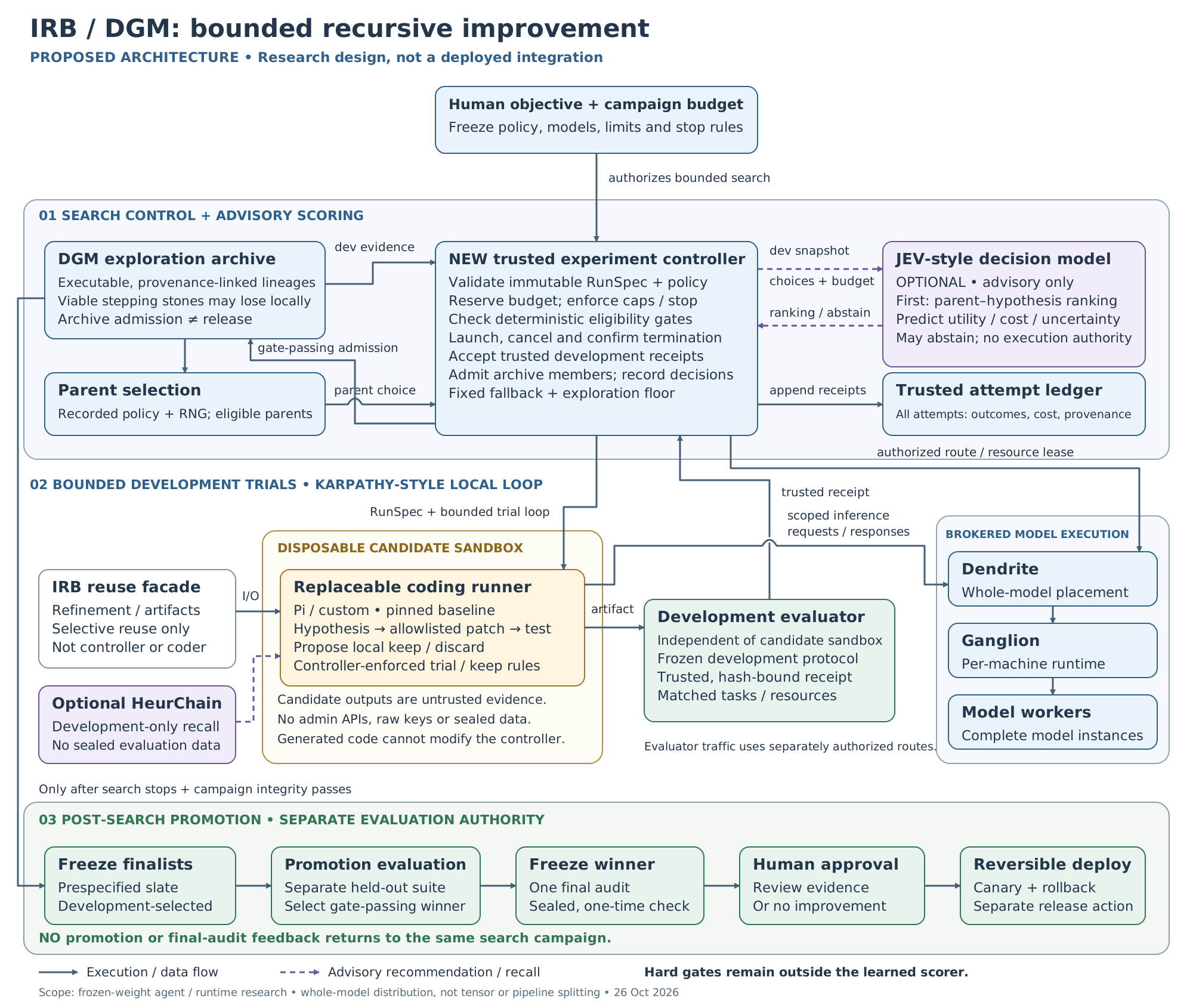
The figure retains its published conceptual labels. Those labels are not asserted to be a canonical match to current inference-fabric repository naming.
02 / Model & LoRA
The proposed runtime selects compatible, versioned LoRA adapters through a serial, request-safe switching sequence. Base weights remain immutable within each trial.
This is not a claim of verified concurrent multi-LoRA serving. The Medina example in the diagram is historical and has not been reverified.
Current status
The public documentation reports tested selection, probability, budget and event controls in an offline scaffold.
Live self-improvement, full JEV integration, runner containment and production deployment of the research system have not been demonstrated. The project makes no claim of frontier results or verified self-improvement gains.
Explore the published documentation